

For many NDIS participants, daily living is not just about completing tasks. It is about feeling safe, settled, and in control of your own home and your own life.
When household assistance is done well, it does far more than keep a home tidy. It creates the conditions for daily living for participants to feel manageable, predictable, and genuinely supported. And for many families across Melbourne's western suburbs, that shift changes everything.
Our Assistance with Daily Life services at JS Choice are designed around this exact idea: that the right support at home makes everything else possible.
What Is Household Assistance Under the NDIS?
Household assistance under the NDIS refers to practical support with the domestic tasks that keep a home running. This includes cleaning, laundry, meal preparation, and basic home organisation.
It sits within the Assistance with Daily Life support category, funded under a participant's Core Supports budget. The NDIS funds this support when a participant's disability genuinely affects their ability to manage these tasks independently.
The key word here is "genuinely." This is targeted, needs-based support for improving daily living for participants whose disability creates real, measurable barriers at home. It is not a general cleaning service.
The Real Impact of Household Assistance on Daily Living for Participants
When people think of household assistance, they often picture a support worker and a mop. The reality is much deeper than that.
Good household assistance does not just clean a kitchen. It removes a source of daily stress, restores a sense of order, and frees up the physical and mental energy a participant needs for the parts of daily living for participants that matter most: goals, relationships, and wellbeing.
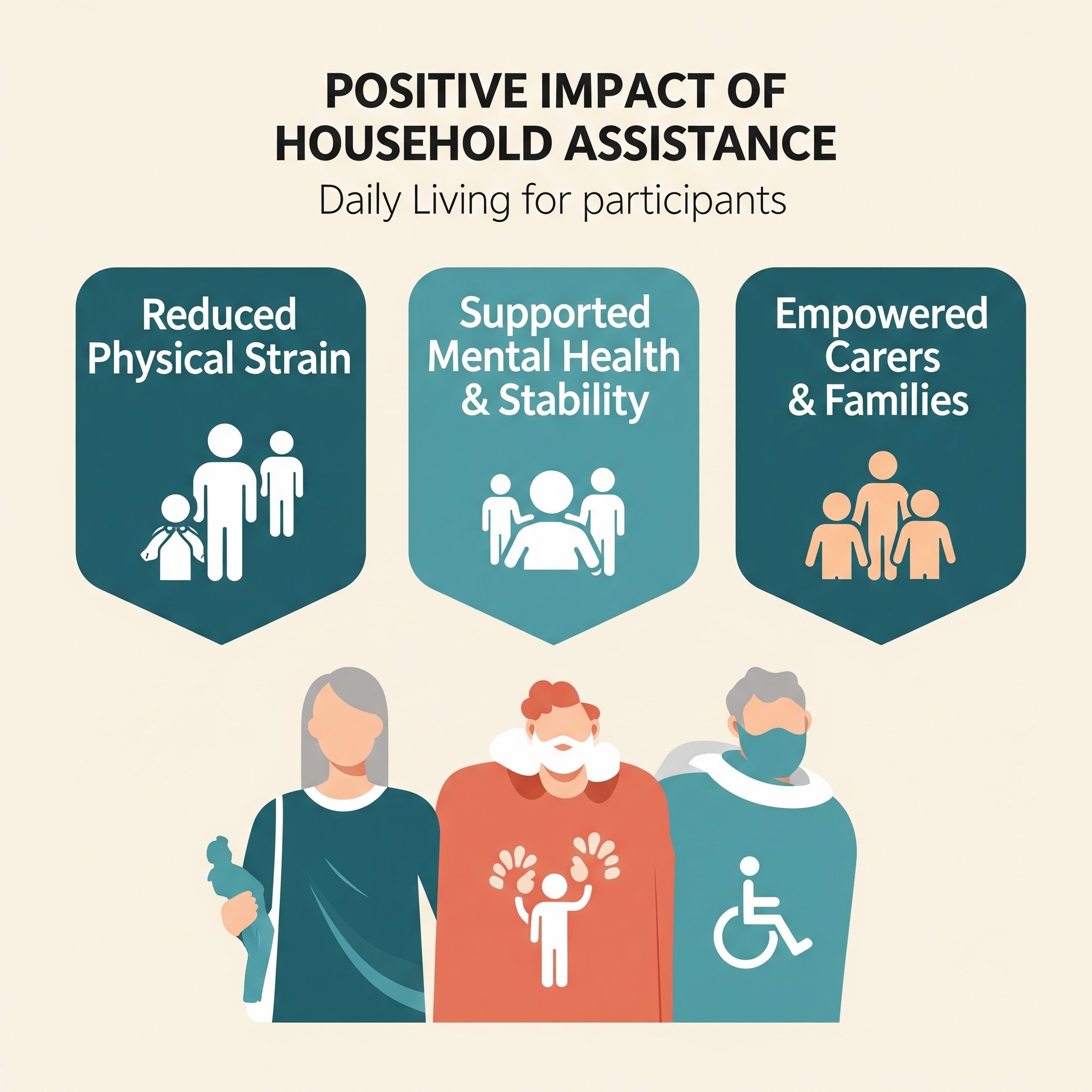
It Reduces Physical Strain
For participants with physical disabilities, chronic fatigue, or pain conditions, household tasks can be exhausting and even unsafe. Bending, lifting, and standing for long periods can cause real harm.
Having a support worker handle these tasks is not a luxury. It is a practical response to a physical need. It protects the participant's body and preserves their energy for activities they genuinely want to engage in.
It Supports Mental Health and Stability
The state of a person's home environment has a direct effect on their mental health. Research consistently shows that cluttered, unclean environments increase anxiety and make it harder to concentrate, rest, and feel calm.
For participants living with psychosocial disabilities, depression, or anxiety, an unmanageable home can quickly become a barrier to recovery.
Regular, reliable household assistance creates a stable foundation for daily living for participants navigating mental health challenges.
It Empowers Careers and Families
Many NDIS participants live with family members or careers who often take on a disproportionate share of household responsibilities. When a support worker steps in, it relieves that pressure.
Careers get time back. Relationships improve. The participant moves from being seen as a source of work to being seen as a person first. That shift in family dynamics is something we hear about again and again from families we support across Point Cook, Tarneit, and Werribee.
The Connection Between Home Environment and Wellbeing
A clean, organised, and well-maintained home is not a bonus. For many people, it is the bedrock of everything else. Routines become easier when the environment is consistent and predictable.
Meals get made. Medications get taken. Sleep improves. The quality of daily living for participants improves across the board when their home environment is stable and manageable.
Improving daily living for participants with Autism Spectrum Disorder (ASD) or sensory sensitivities depends heavily on getting the home environment right. Clutter, mess, and unpredictability can cause genuine distress.
A neuro-affirming approach to household assistance recognises this and adapts accordingly, working with the participant's preferences rather than against them.
At JS Choice, our support workers are trained to understand these connections. They do not just complete tasks. They notice what helps a participant feel calm, what triggers distress, and how to adjust their approach to make the experience genuinely supportive.
Related Reading:
Building Independence, Not Dependency
This is a point that matters deeply to us at JS Choice, and it reflects Jan Fardowsi's founding philosophy: the goal of any support is to build the participant up, not to create reliance on a service.
For some participants, household assistance is a long-term need that will not change significantly. For others, it is a stepping stone. A support worker might gradually hand back tasks as a participant builds confidence or capacity. They might teach practical skills alongside completing them. They might support a participant to develop their own routines and systems.
The NDIS support categories are designed to fund what is reasonable and necessary. JS Choice works alongside each person to ensure support for daily living for participants genuinely reflects their goals and capabilities, not just their limitations.
Every participant we work with has a story. Our job is to support the next chapter of it.
What Household Assistance Looks Like in Practice
It is worth being concrete about what daily living support for participants actually involves, because every person's needs are different.
A support worker from JS Choice might assist with any combination of the following, depending on what is in the participant's NDIS plan:
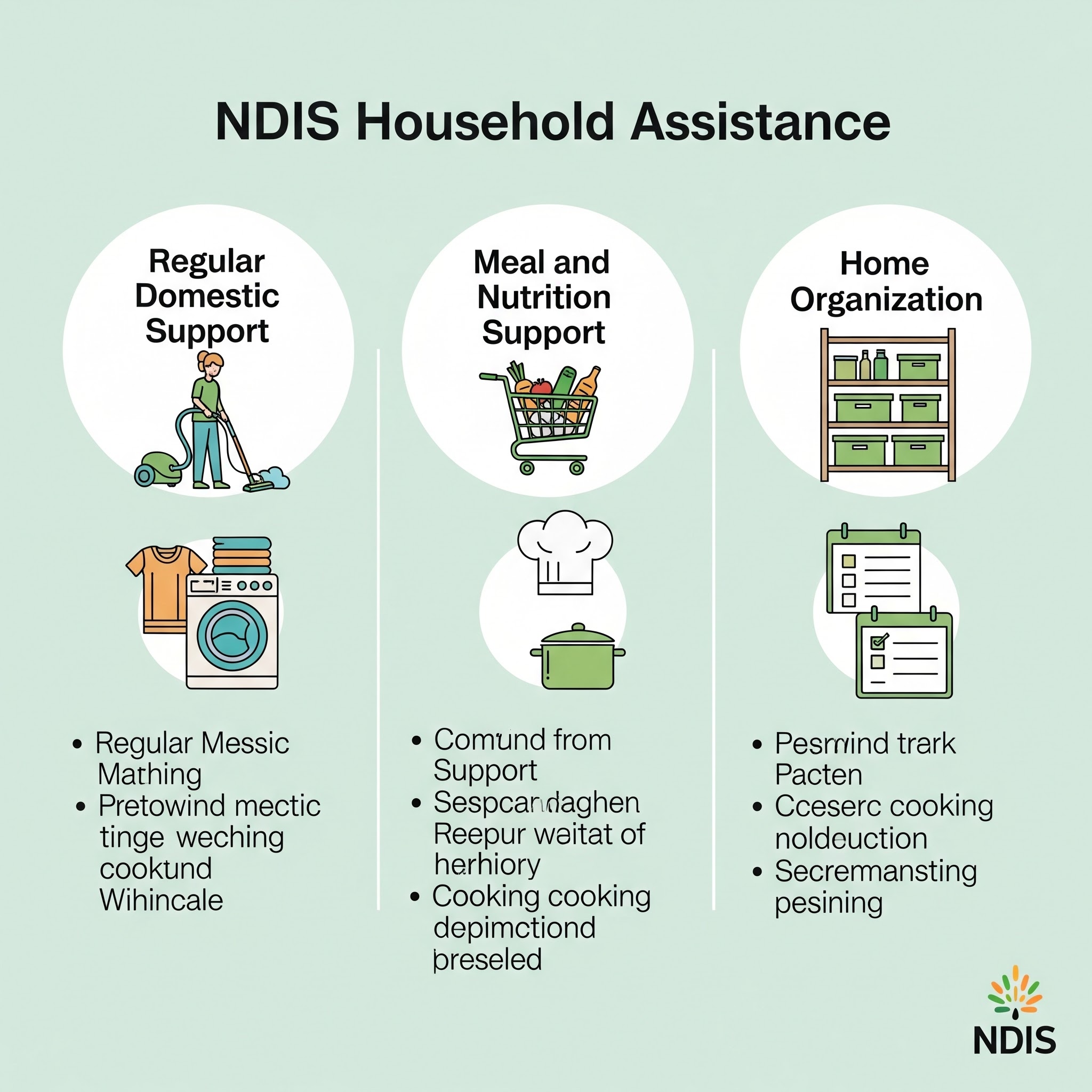
Regular domestic support:
Vacuuming, mopping, and general cleaning
Bathroom and kitchen cleaning
Changing and washing bed linen
Laundry, drying, and folding
Meal and nutrition support:
Grocery shopping assistance
Meal planning and preparation
Cooking and kitchen clean-up
Home organisation:
Decluttering and tidying living spaces
Setting up systems that work for the participant's routine
Supporting a predictable, consistent home environment
Support is flexible. Some participants need help once a week. Others need daily assistance. The frequency and type of support is guided by the participant's NDIS plan and reviewed over time as needs change.
How to Know If This Support Is Right for You
If you are asking this question, it is probably already relevant to your situation. Household assistance is one of the most effective ways to improve daily living for participants across a wide range of disability types and circumstances. The clearest signs it could help you include:
Household tasks are frequently left undone because of physical pain, fatigue, or cognitive difficulty
You or your family member feels overwhelmed trying to keep up with domestic responsibilities
The state of the home is causing stress, anxiety, or conflict
You are spending energy on household tasks that you would rather direct toward goals, work, therapy, or relationships
A carer is burning out from managing both their own needs and the domestic needs of the household
If any of these resonate, the next step is to check your NDIS plan for Core Supports funding under Assistance with Daily Life. A registered provider like JS Choice can walk you through exactly what your plan allows and how to get started.
How JS Choice Group Can Help?
Improving daily living for participants starts with having the right team alongside you. We have seen firsthand how the right household assistance transforms not just a home, but a person's entire sense of possibility. Our Assistance with Daily Life services are delivered by experienced, culturally aware support workers who genuinely understand what good household assistance looks like in practice.
We work with participants and their families across Melbourne's western and northern suburbs. Every person we support receives a tailored approach, shaped around their goals, their home environment, their preferences, and their culture.
If you are ready to take the next step, we would love to hear from you.