

The NDIS can feel like a system with its own language, its own rules, and its own maze of steps. For many families, knowing where to even begin is the first barrier. The good news is that understanding how to apply for the NDIS is more straightforward than it appears once you break it down.
This guide explains exactly how to apply for the NDIS, step by step. You do not need a lawyer, a professional advocate, or a thick folder of paperwork to get started. You need to understand the eligibility criteria, gather the right evidence, and know where to submit your request.
Work through each step below and you will finish reading knowing exactly what to do next.
What Is the NDIS and Who Is It For?
The National Disability Insurance Scheme (NDIS) is the Australian Government's program for funding support and services for people with permanent and significant disability. It is funded and administered by the National Disability Insurance Agency (NDIA).
The NDIS is designed for people whose disability is likely to be permanent and has a substantial impact on their ability to manage daily life. The scheme exists specifically to fund reasonable and necessary supports that help participants live as independently as possible and engage fully with their community.
If you are aged 65 or over, the relevant system is My Aged Care rather than the NDIS. For children under 7 with developmental concerns, an Early Childhood Partner can connect your family with support even before a formal NDIS plan is in place.
Do You Meet the NDIS Eligibility Criteria?
Before you formally try to apply for the NDIS, it is worth confirming you meet the three access requirements. Understanding how to apply for the NDIS starts with these three criteria. These are set by the NDIA and must all be satisfied.
Age Requirement
You must be under 65 years of age at the time you first apply. If you acquire a disability after 65, My Aged Care is the relevant pathway. The age requirement is one of the first things to check before you try to apply for the NDIS. If you are already an NDIS participant when you turn 65, you can continue to receive NDIS support.
Residency Requirement
You must be an Australian citizen, a permanent resident, or hold a Protected Special Category Visa. You must also be living in Australia at the time of your application.
Disability or Early Intervention Requirement
This is the most detailed of the three criteria, and it has two pathways.
The disability pathway applies where you have a disability caused by a permanent impairment, and that impairment substantially reduces your functional capacity in one or more of these areas: communication, social interaction, learning, mobility, self-care, or self-management.
The early intervention pathway applies where early support is likely to reduce your future support needs. This pathway is commonly used for young children diagnosed with ASD, hearing loss, or significant developmental delay, but it can also apply to adults in some circumstances.
You do not need to have a specific diagnosis to meet the disability criteria. What matters is the functional impact of your impairment on your daily life.
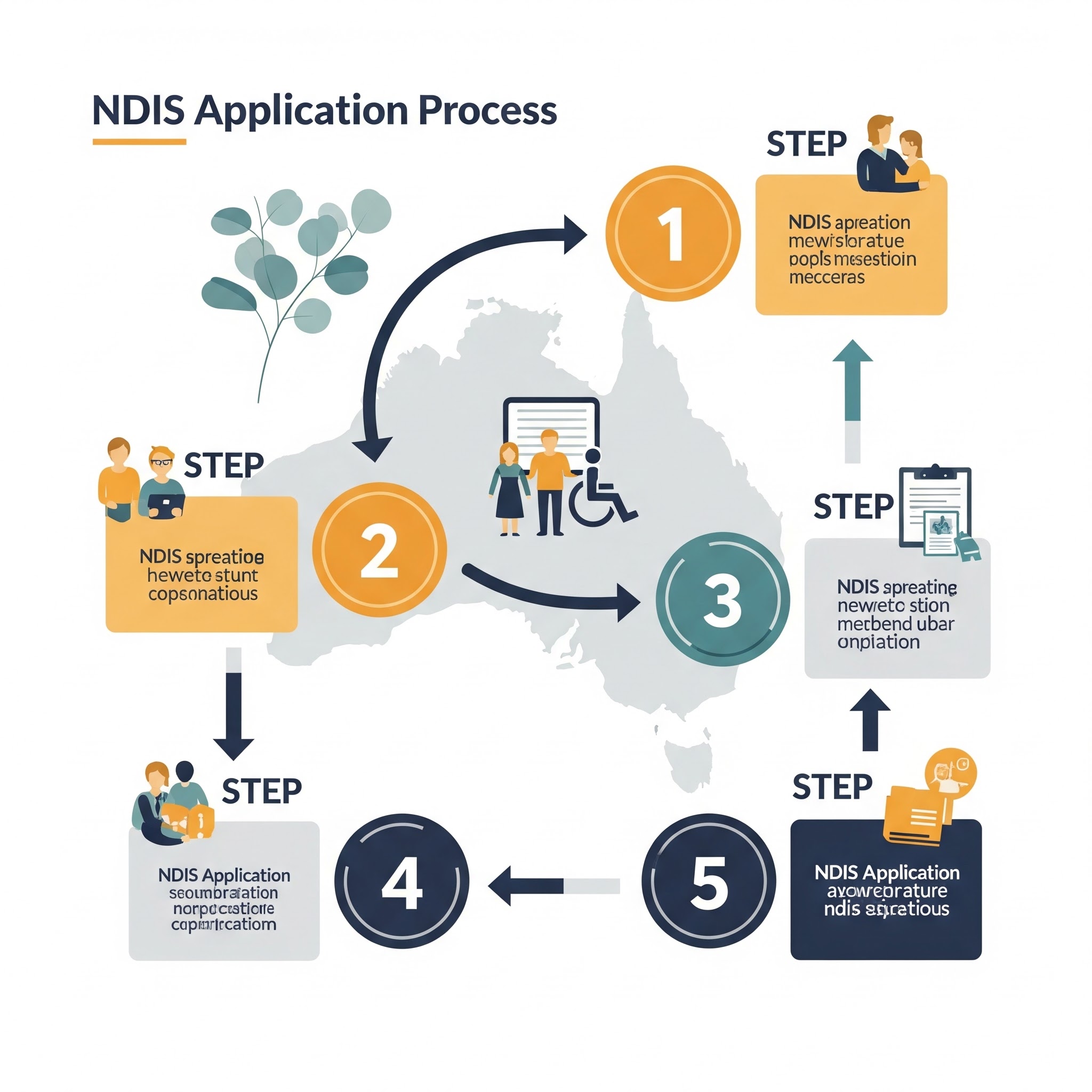
How to Apply for the NDIS: Five Clear Steps
Here is the step-by-step process for how to apply for the NDIS.
Step 1: Check Your Eligibility
The first step in how to apply for the NDIS is confirming your eligibility. Use the NDIS Access Checker at ndis.gov.au to get a preliminary sense of whether you are likely to meet the access criteria. This is not a formal decision, but it gives you a starting point.
If you are unsure whether your disability meets the criteria, speaking to your GP, specialist, or a Support Coordinator early can help you understand how to present your needs accurately.
Step 2: Gather Your Supporting Evidence
One of the most critical steps when learning how to apply for the NDIS is gathering strong evidence before you submit. Your access request will be assessed using the evidence you provide. This typically includes reports or letters from treating health professionals who know your disability well. We cover the specifics of what evidence to gather in the next section.
Step 3: Submit Your Access Request
When you know how to apply for the NDIS and are ready to submit, there are three ways to lodge your access request:
By phone: Call the NDIS on 1800 800 110. You can make a verbal access request and the NDIS will send you a form to complete.
Online: Through your myNDIS account at my.ndis.gov.au.
Through a Local Area Coordinator (LAC) or Early Childhood Partner: These are NDIS-funded community partners who can help you complete and submit your access request at no cost to you.
In Melbourne's western suburbs, Local Area Coordinators operate across Point Cook, Tarneit, Werribee, and surrounding areas. They are one of the most accessible ways to learn how to apply for the NDIS and will support you through the whole process at no cost. You can find your local LAC through the NDIS website or by calling the NDIS contact line.
Step 4: The NDIS Reviews Your Request
Once your access request is received, the NDIA reviews your evidence and determines whether you meet the access criteria. They may contact you or your treating health professionals for additional information during this process.
Step 5: Receive the Decision and Plan Your Next Steps
If your access request is approved, the NDIA will contact you to begin the planning process. If it is not approved, you have the right to request an internal review of the decision. We cover this in more detail below.
What Evidence Do You Need for Your NDIS Application?
Knowing how to apply for the NDIS successfully comes down to two things: meeting the criteria and providing the right evidence. The strength of your supporting evidence is one of the biggest factors in whether your access request is approved. The NDIA uses your evidence to understand the nature of your disability, its likely permanence, and its functional impact on your daily life.
Strong evidence typically includes:
A report or letter from your treating GP, specialist, or allied health professional that describes your diagnosis, how long you have had the condition, and why it is likely to be permanent
Functional assessments from an occupational therapist, speech pathologist, physiotherapist, or psychologist that explain in detail how your disability affects daily activities
For children, reports from early childhood educators, paediatricians, or developmental specialists
The NDIA does not make access decisions based on diagnosis alone. A letter that says "this person has ASD" or "this person has cerebral palsy" is not enough. The evidence needs to describe the functional impact of the disability in clear, specific terms.
If your existing reports do not address functional capacity directly, it is worth asking your health professionals to provide updated documentation before you submit your access request. This step takes time, but it significantly improves your application.
What Happens After You Submit Your Access Request?
After you submit your access request, the NDIA has a set timeframe to make a decision. This is the final stage in the process of how to apply for the NDIS, and it is largely in the NDIA's hands from here. You will be notified of the outcome in writing.
If your access request is approved, the next step is an NDIS planning meeting. This is a conversation between you and an NDIS planner or LAC about your goals, your support needs, and what funding would be reasonable and necessary in your plan. It helps to prepare for this meeting by thinking clearly about what you want your life to look like and what types of support would help you get there.
A Support Coordinator, or a registered provider like JS Choice, can help you prepare for your planning meeting and understand how to get the most from your NDIS plan once it is in place. This is where the work you put in to understand how to apply for the NDIS starts to pay off. Our NDIS access request support service is specifically designed to help families navigate this process.
What If Your NDIS Application Is Unsuccessful?
Knowing how to apply for the NDIS does not guarantee approval, and an unsuccessful result does not necessarily mean the end of the road. If the NDIA decides you do not meet the access criteria, you can request an internal review of that decision.
An internal review means a different NDIA delegate reviews your application and the evidence. If you receive new or stronger evidence in the meantime, this is the time to include it. If the internal review also finds against you, you can apply to the Administrative Review Tribunal for an independent review.
Many unsuccessful applications are the result of insufficient or poorly framed evidence rather than a genuine ineligibility. Before giving up or moving straight to a review, speak to a Support Coordinator or advocacy organisation about whether your evidence could be strengthened. In many cases, an updated report from a treating health professional makes all the difference. The right to review means that a first unsuccessful attempt to apply for the NDIS is not necessarily the final answer.
How JS Choice Group Can Help
At JS Choice, we know that learning how to apply for the NDIS for the first time can feel like a lot. We have supported many families in Melbourne's western suburbs through exactly this process. We have supported many families in Melbourne's western suburbs through this process, from understanding eligibility to preparing for planning meetings.
Whether you are at the very beginning of the NDIS journey or trying to understand what went wrong with a previous application, our team is here to help. Explore our NDIS access request support or reach out to us directly for a conversation about where you are at.
Related reading: