When a participant's disability involves complex medical or clinical needs that require specific procedures as part of their daily care. These participants need NDIS high intensity personal care.
NDIS high intensity personal care covers a defined set of support tasks that carry a higher level of clinical risk. They require workers with verified training, demonstrated competency, and clear clinical oversight.
When delivered by the right provider, these supports allow participants with complex health needs to live at home safely, with dignity and genuine independence.
This guide explains what NDIS high intensity personal care involves, what the rules are around how it must be delivered, and what families and carers should look for when choosing a provider.
What Is NDIS High Intensity Personal Care?
NDIS high intensity personal care refers to a specific category of personal support tasks that involve clinical procedures or complex health needs. These tasks carry a higher level of risk and require support workers who have been formally trained and assessed as competent by a qualified health professional, typically a registered nurse.
These supports fall under Support Category 01: Assistance with Daily Life, within the Core Supports budget of a participant's NDIS plan. The NDIS identifies them as High Intensity Daily Personal Activities and lists them as separate support items within the Support Catalogue with dedicated funding rates.
Importantly, NDIS high intensity personal care can only be delivered by a registered NDIS provider. Unregistered providers are not permitted to deliver these supports regardless of the worker's individual training. This is a firm requirement under the NDIS Practice Standards and Quality Indicators.
How High Intensity Support Differs from Standard Personal Care
Standard personal care includes the everyday tasks most people associate with disability support: showering, dressing, grooming, meal preparation, and mobility assistance.
These tasks require trained and capable workers, but they do not require clinical competency assessment or the oversight of a health professional.
NDIS high intensity personal care sits in a different category because the tasks involved carry clinical risk. A mistake in complex bowel care, for example, or in managing a participant's tracheostomy, can result in serious harm.
The stakes are higher, the training requirements are stricter, and the provider's clinical governance systems must be in place before any worker can deliver these supports.
The key distinctions are:
Worker training: High intensity workers must be assessed as competent for each specific task by a registered nurse or relevant clinician, not just complete a general training course
Clinical oversight: Providers must have protocols developed by health professionals that workers follow for each participant
Provider registration: Only registered NDIS providers can claim and deliver high intensity support items
Separate pricing: NDIS high intensity personal care has its own support items and higher price limits in the NDIS Support Catalogue to reflect the additional skill and risk involved
What Support Tasks Fall Under NDIS High Intensity Personal Care?
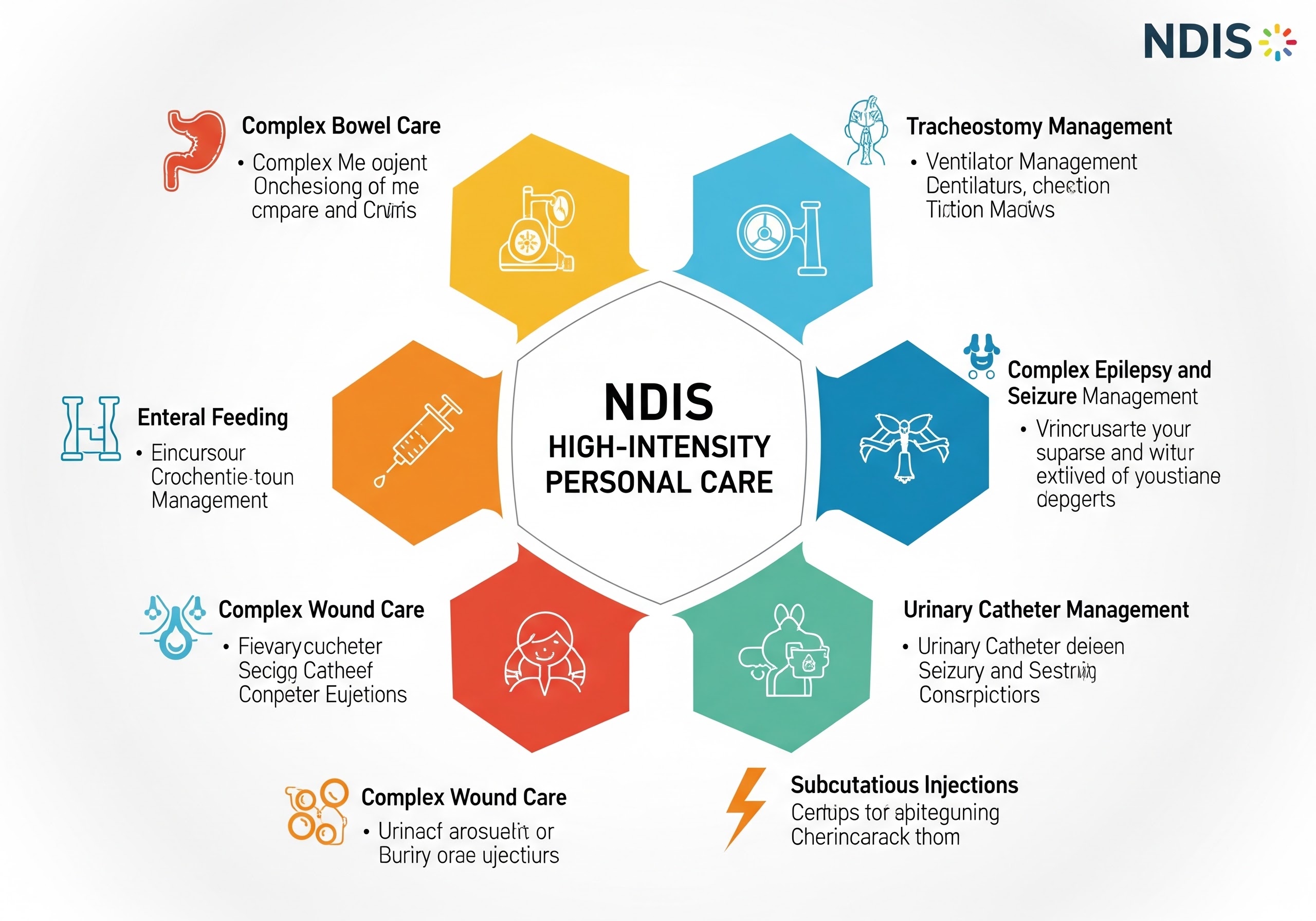
The NDIS defines a specific list of support tasks that qualify as high intensity daily personal activities. These are clinical procedures that become part of a participant's daily care routine because of their disability or health condition.
Complex Bowel Care
This includes managing a participant's bowel function where their disability means they cannot do this independently. It covers bowel programs developed with a healthcare professional and may involve digital stimulation, suppositories, or manual evacuation under a documented clinical protocol.
Tracheostomy Management
Participants with a tracheostomy require skilled daily care to keep the airway clear and safe. This includes suctioning, cleaning, and changing inner cannulas. Workers delivering this support must be assessed as competent by a registered nurse and must follow a written care plan developed by the treating team.
Ventilator Management
For participants who rely on a ventilator, support workers may be trained to manage equipment settings, circuits, and emergency responses under a strict clinical protocol. This is one of the highest risk areas within NDIS high intensity personal care and requires the most rigorous oversight.
Enteral Feeding
Participants who receive nutrition through a feeding tube, such as a PEG or nasogastric tube, require trained workers to prepare feeds, manage tube care, and respond safely to complications. Workers must be competent in the specific tube type and feeding system used by the participant.
Complex Wound Care
Some participants require ongoing wound management as part of their daily care that goes beyond what standard personal care can safely cover. This includes dressings developed under a wound management plan by a nurse or healthcare professional.
Urinary Catheter Management
This includes care of indwelling or suprapubic catheters, including emptying drainage bags, monitoring for complications, and following catheter care protocols developed by a healthcare professional.
Subcutaneous Injections
Where a participant requires regular injections, such as insulin for diabetes management, a trained support worker may deliver this under a documented protocol signed off by the treating clinician.
Complex Epilepsy and Seizure Management
Some participants with epilepsy require trained support workers who can administer emergency medications, manage airway position, and respond safely to complex seizure presentations according to an individualised management plan.
Who Qualifies for NDIS High Intensity Personal Care?
A participant qualifies for NDIS high intensity personal care when their disability or health condition requires one or more of the clinical support tasks listed above as a regular part of their daily care. Funding for high intensity supports is included in a participant's NDIS plan under Support Category 01, with specific high intensity line items.
Approval is generally based on documented health needs, assessments from treating health professionals such as a GP, nurse, or specialist, and evidence that these tasks are disability-related and not medical treatments covered by the health system. The NDIS support categories page has further detail on what is claimable under Assistance with Daily Life.
If a participant's complex health needs are not yet reflected in their NDIS plan, this can be raised at a plan review. A Support Coordinator can help prepare the documentation needed to make the case for high intensity funding. For participants with new or changing health needs between plan reviews, an urgent plan review can be requested.
What to Look for in a High Intensity Personal Care Provider
Choosing a provider for NDIS high intensity personal care is one of the most consequential decisions a participant or family will make. The clinical stakes are real. These questions will help you assess any provider properly.
Are they a registered NDIS provider? This is not optional for high intensity supports. Ask to see the provider's NDIS registration and confirm they are registered for the specific support items you need. You can verify this independently through the NDIS Provider Finder.
How do they assess and verify worker competency? Reputable providers will have a clear process where a registered nurse or qualified clinician formally assesses each worker's competency for each specific high intensity task. Ask how often competencies are reviewed and what happens if a worker's skills are deemed insufficient.
Do they have clinical governance in place? Providers delivering NDIS high intensity personal care must have written protocols for each clinical task, developed by a health professional specific to each participant. Ask whether this is done before support begins, and who is responsible for developing and reviewing those protocols.
What is their incident and escalation process? A provider who cannot clearly describe their process for managing clinical incidents, escalating concerns, or responding to emergencies in a participant's care is not one you want delivering high intensity supports.
Our assistance with daily life services at JS Choice are delivered by workers who meet the training and competency requirements for the specific supports each participant needs. We work closely with treating health teams to ensure every high intensity protocol is in place before support begins.
How JS Choice Group Can Help
At JS Choice, we understand that NDIS high intensity personal care is not simply a support task. It is a clinical responsibility that requires the right training, the right systems, and the right people.
We work closely with the treating health teams of participants who require high intensity supports, and we hold our workers to the competency and governance standards the NDIS requires. For families navigating this area for the first time, we are also here to help you understand what to ask and what to expect.
If you would like to talk through whether JS Choice is the right fit for your participant's needs, reach out to us directly or submit a referral and we will be in touch.
Related reading: