NDIS social skills development is one of the most meaningful and lasting outcomes that group programs can deliver. And yet it is one that does not always get the attention it deserves in conversations about what group participation actually achieves.
For many NDIS participants, the ability to communicate with others, navigate group settings, form friendships, and participate in community life is directly connected to their independence, their mental health, and their quality of life.
Group programs provide a unique environment where these skills can be practised, built, and reinforced in a real and meaningful way. This post looks at exactly how group programs support NDIS social skills development.
Why Social Skills Matter for NDIS Participants
Social skills sit at the intersection of almost everything the NDIS is designed to support. The ability to communicate, cooperate, manage conflict, read social cues, and form genuine connections affects employment, housing, healthcare, family relationships, and community participation.
For many NDIS participants, disability directly affects social functioning. This might be through differences in communication, sensory sensitivities that make group environments challenging, anxiety that limits social confidence, or cognitive differences that affect reading social situations accurately.
NDIS social skills support is recognised as a legitimate and important goal under participant plans. When developed well, social skills do not just help participants get along in group settings. They open doors to employment, broader community participation, and a richer daily life.
How Group Programs Create the Right Environment for Social Development
Individual therapy sessions can address social skills in a clinical sense. But there is something that only happens in a genuine group setting: the opportunity to practise with real people, in real time, in situations that carry real social weight.
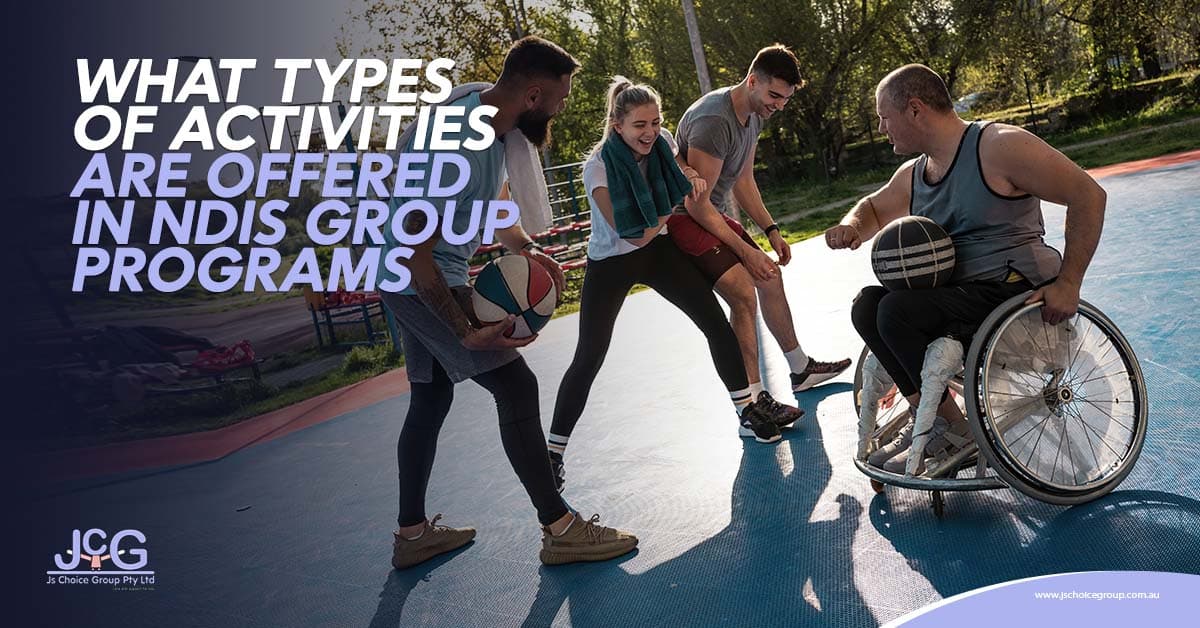
NDIS social skills development through group programs works because group settings replicate the complexity of everyday social life. There are other people with their own communication styles, their own moods, their own perspectives.
There are situations where turns need to be taken, where misunderstandings happen, where conflicts arise and need to be resolved. This is where growth happens. Not in rehearsed scripts, but in the unpredictable, sometimes messy, always authentic experience of being with other people.
Well-run group programs manage this environment carefully. Support workers and facilitators create a setting that is structured enough to be safe, and open enough to let genuine social interaction unfold. That balance is what makes group programs uniquely effective for NDIS social skills development.
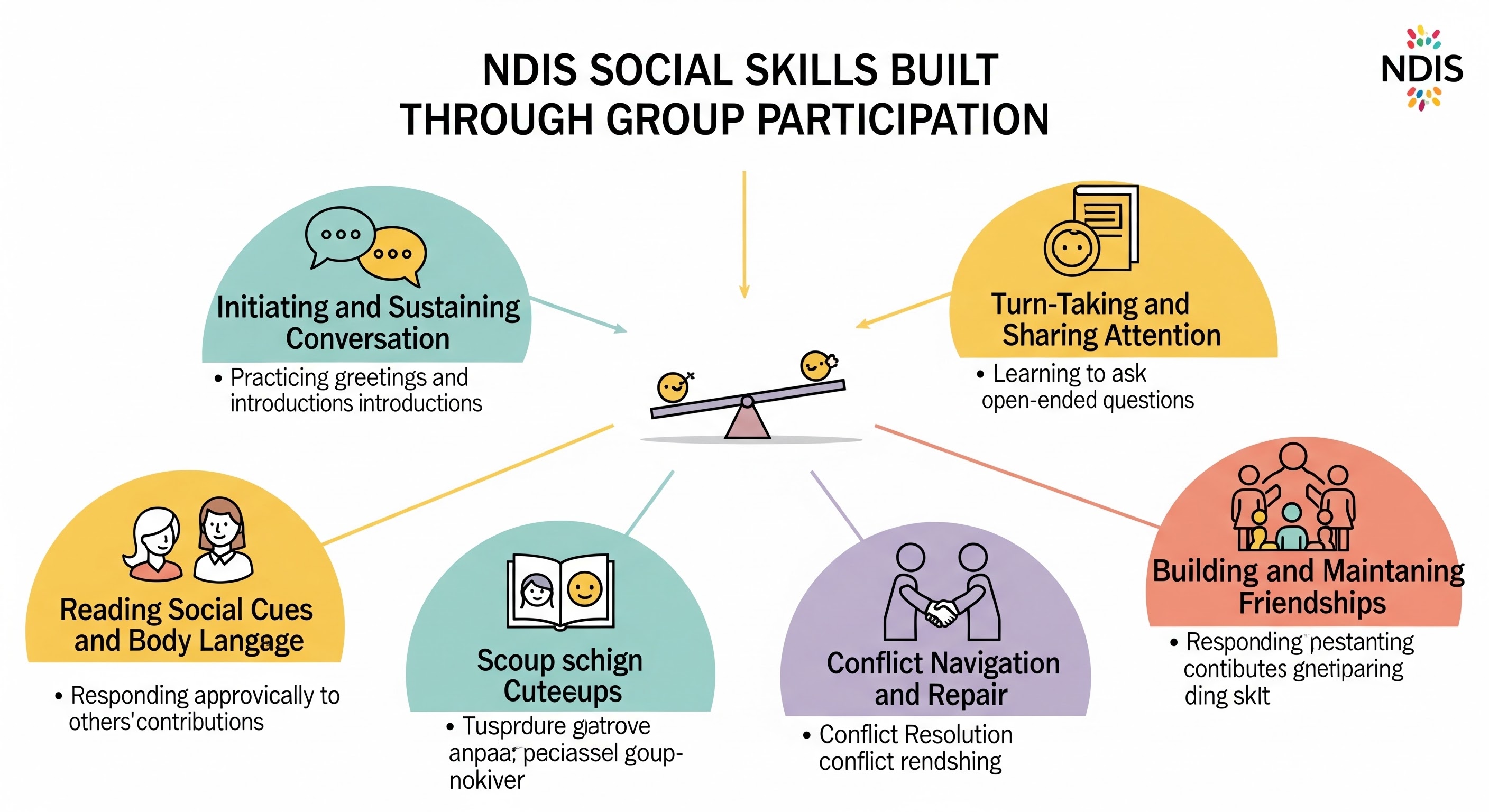
Specific NDIS Social Skills Built Through Group Participation
Different group programs build different skills, depending on the structure, activities, and goals involved. The following are some of the most commonly developed NDIS social skills through group participation.
Initiating and Sustaining Conversation
Many participants find starting conversations difficult. Group programs provide repeated, low-stakes opportunities to practise conversation openers, respond to what others say, and keep a conversation going past the initial exchange.
Over time, participants who struggle with conversation initiation often develop a set of reliable strategies they can use across different social contexts, from a group activity session to a job interview.
Turn-Taking and Sharing Attention
Group settings require constant navigation of turn-taking, whether that is waiting for a chance to speak, sharing equipment, or participating in a group decision. These are foundational NDIS social skills that translate directly into classroom, workplace, and community settings.
Participants who practise turn-taking in a supportive group environment develop greater patience, self-regulation, and the social awareness needed to participate in group situations without becoming overwhelmed or withdrawing.
Reading Social Cues and Body Language
Understanding what others are communicating beyond words is one of the most complex and important NDIS social skills a participant can develop.
Group settings make this possible in a way no one-on-one session can replicate, because there are multiple people expressing different emotions, reactions, and social signals at once. For participants with ASD, this area of development is particularly significant.
A neuro-affirming group program does not demand that participants mask or suppress their natural communication style. Instead, it builds awareness of social context in ways that are authentic and respectful of neurodivergent experience.
Conflict Navigation and Repair
Group settings inevitably involve moments of disagreement, frustration, or miscommunication. These moments, when handled well by skilled facilitators, become some of the most valuable learning opportunities a group program can offer.
Learning to name a feeling without acting on it destructively, to disagree respectfully, or to repair a misunderstanding with another person are NDIS social skills with genuinely life-changing impact. They affect relationships with family, support workers, employers, and peers.
Building and Maintaining Friendships
Perhaps the most significant NDIS social skills outcome of regular group participation is the development of genuine friendships. Participants who attend the same group program consistently over time build familiarity, trust, and reciprocal care with their peers.
These friendships often extend beyond the group setting itself. They represent a form of natural social support that complements formal disability support and contributes to long-term wellbeing and belonging.
Group Programs for Participants with ASD and Communication Differences
NDIS social skills development looks different depending on each participant's disability, communication style, and goals. For participants with Autism Spectrum Disorder (ASD) or other conditions affecting communication, group programs require a particularly thoughtful approach.
A neuro-affirming group program does not treat social differences as deficits to be corrected. It recognises that autistic participants may communicate, connect, and engage with others in ways that are different from neurotypical norms, but that are no less valid or meaningful.
Good NDIS social skills programming for autistic participants:
Allows for different communication modalities including AAC, written communication, or visual supports
Accounts for sensory needs in the physical environment of the group setting
Avoids forcing eye contact, scripted social responses, or masking behaviours
Values the social connections autistic participants form, even if they look different from neurotypical friendships
Builds on the participant's existing strengths and interests as a foundation for social engagement
At JS Choice, our group and centre-based activity programs are designed with neuro-affirming principles embedded from the outset. We work with participants across a wide range of communication styles and support needs.
The Long-Term Impact of Social Skills on Independence and Wellbeing
The benefits of NDIS social skills development through group participation extend well beyond the group setting itself.
Participants who build genuine social confidence and skills through group programs are better positioned to manage job interviews, workplace relationships, and community interactions independently. They are more likely to seek help when they need it, to advocate for themselves, and to maintain the relationships that protect against social isolation.
The NDIS support categories recognise social participation as a core outcome area precisely because social connection and social skills are so foundational to everything else.
The research on social isolation and disability is clear. Social isolation increases risk of mental health conditions, reduces physical health outcomes, and limits the opportunities available to a person across every life domain. Investing in NDIS social skills through group programs is therefore not just about helping participants make friends. It is about protecting their long-term health and opening the doors to a fuller life.
What to Look for in a Group Program Focused on Social Development
If NDIS social skills development is a goal for you or a participant you support, here is what to look for in a group program.
Consistent group membership Social skills develop fastest when participants see the same people repeatedly. A program that has stable, consistent group membership gives participants the opportunity to build real relationships over time, not just practise interactions with strangers.
Qualified, socially skilled facilitators Group facilitators should be trained not just in disability support, but in group dynamics and social development. They should know when to intervene, when to step back, and how to support participants without creating dependency.
A neuro-affirming and culturally safe environment A group that truly includes everyone creates space for different communication styles, different cultural expressions of social connection, and different ways of participating. In Melbourne's western suburbs, where participants come from richly diverse backgrounds, this is not optional. It is essential.
Clear links to participant goals A good group program connects to the goals in each participant's NDIS plan. Progress in NDIS social skills should be observable, documented, and reportable at plan reviews.
Our social and community participation services at JS Choice are built on all of these principles, designed to help every participant feel genuinely included and genuinely growing.
How JS Choice Group Can Help
At JS Choice, we know that NDIS social skills development happens when participants feel genuinely safe, genuinely included, and genuinely seen. Our group programs across Melbourne's western and northern suburbs are designed to create exactly that environment.
We work with participants across Point Cook, Tarneit, Werribee, Hoppers Crossing, Laverton, Craigieburn, Footscray, and surrounding areas. Whether you are supporting a young person with ASD, an adult looking to build community connections, or anyone in between, we would love to talk about what is possible.
Related reading: