
If you have NDIS therapeutic support funding in your plan, you may be wondering exactly which NDIS therapy services that budget can be spent on. The answer is broader than many participants realise.
NDIS therapy services span occupational therapy, speech pathology, psychology, physiotherapy, behaviour support, and several other specialist disciplines. Each one addresses different needs and produces different outcomes. Understanding what is available helps you use your plan funding to its full potential.
This guide walks through every major NDIS therapy service category, what each one involves, and how to know which services belong in your plan.
How NDIS Therapy Services Are Categorised?
Before diving into specific NDIS therapy services, it helps to understand where they sit in your plan. All funded therapy falls under the Capacity Building budget, specifically within Support Category 15: Improved Daily Living Skills. You can review the full support category list on the NDIS website.
This is a dedicated funding line separate from your Core Supports budget, which funds day-to-day care and household support. Capacity Building funding is specifically designed to build skills and independence over time.
For a full overview of how NDIS therapy services are structured and funded within the plan framework, our guide to therapeutic supports in the NDIS covers the complete picture. This post focuses on the specific services and what each one delivers.
Occupational Therapy
Occupational therapy (OT) is one of the most widely accessed NDIS therapy services across all age groups and disability types. Occupational therapists assess how a participant is managing the tasks of daily life and identify where functional barriers are getting in the way.
OT under NDIS therapy services can include:
Functional capacity assessments to inform plan funding decisions
Home modification recommendations to improve safety and access
Prescription and trial of assistive technology and mobility aids
Skill-building sessions focused on cooking, self-care, and home management
Support for participants transitioning to more independent living arrangements
Sensory processing assessments and strategies for participants with ASD or ADHD
For many participants, an OT assessment is one of the first and most important steps after receiving an NDIS plan. The functional capacity assessment produced by an OT often forms the foundation of evidence for plan reviews and funding decisions.
Speech Pathology
Speech pathology is funded under NDIS therapy services where a participant's disability affects their ability to communicate, process language, or in some cases, eat and drink safely.
Speech pathologists work with participants across a wide range of communication needs:
Developing spoken language in children and adults with ASD, Down syndrome, or intellectual disability
Supporting people with acquired brain injury to rebuild communication after stroke or trauma
Prescribing and training participants in augmentative and alternative communication (AAC) systems, including communication devices and symbol-based systems
Addressing voice disorders and fluency issues including stuttering
Dysphagia management, which covers swallowing and feeding difficulties
Communication is foundational to everything else in a person's life. When NDIS therapy services include speech pathology, the downstream effects on social connection, self-advocacy, and independence are significant.
Psychology and Mental Health Therapy
Psychology is a funded NDIS therapy service for participants whose disability includes a psychosocial component, or where mental health conditions form a significant part of their diagnosed disability.
NDIS-funded psychology services can address:
Anxiety, depression, and trauma as they relate to a participant's disability
Emotional regulation and coping strategies for participants with ASD or ADHD
Cognitive assessments to inform support planning and goal-setting
Building resilience and life skills for participants with psychosocial disability
Goal-directed therapy sessions linked to a participant's NDIS plan outcomes
It is important to understand the boundary here. The NDIS does not fund psychology for general mental health treatment that Medicare covers. NDIS therapy services through psychology are specifically for disability-related mental health needs.
A support coordinator can help clarify what applies to your individual situation.
Physiotherapy and Exercise Physiology
Both physiotherapy and exercise physiology appear under NDIS therapy services, and while they overlap in some areas, they serve different purposes. Physiotherapy focuses on physical rehabilitation, injury management, pain, and mobility.
It is particularly relevant for participants with physical disabilities, neurological conditions, or those recovering from injury or surgery. Physiotherapists develop programs to restore function, manage pain, and maintain physical capacity as conditions change over time.
Exercise physiology focuses on the use of structured physical activity and exercise programs to manage chronic conditions, improve physical function, and support overall health.
For NDIS participants, exercise physiologists often work with people who have complex health needs where specific, supervised exercise programs are clinically indicated.
Both disciplines are available under the Capacity Building budget. Whether one or both are appropriate depends on the participant's disability, their goals, and what is included in their plan.
Behaviour Support
Positive behaviour support is a specialised NDIS therapy service delivered by registered practitioners who hold specific qualifications under the NDIS Quality and Safeguards Commission framework.
Behaviour support is funded where a participant shows behaviours of concern that affect their safety or the safety of those around them. The registered behaviour support practitioner works with the participant, their family, and their support team to:
Understand the reasons and triggers behind behaviours of concern
Develop a Behaviour Support Plan (BSP) that is person-centred and practical
Reduce or eliminate the use of restrictive practices over time
Build the participant's own skills and strategies for managing challenging situations
Train support workers and family members to implement the plan consistently
Behaviour support is one of the most tightly regulated therapy types under the NDIS. Providers must be registered with the NDIS Commission, and all restrictive practices must be reported and authorised through the correct legal processes.
Other NDIS Therapy Services
Beyond the core disciplines, several additional NDIS therapy services may be funded depending on a participant's individual plan and assessed needs.
Dietetics is funded where a participant's disability directly affects their nutritional needs or their ability to manage their diet safely. This includes participants with feeding difficulties, metabolic conditions, or complex health needs related to their disability.
Music therapy and art therapy are funded for participants where clinical evidence supports their use as therapeutic interventions. These are not recreational activities. They are structured, goal-directed therapy sessions delivered by qualified practitioners.
Early childhood supports include a range of NDIS therapy services for children under 9 with developmental delays or disabilities. These are delivered through the NDIS Early Childhood Approach and typically involve OT, speech pathology, and developmental support in home and community settings.
Counselling can be funded where it is specifically linked to disability-related needs and delivered by a qualified practitioner. General counselling for wellbeing is not typically covered under the NDIS.
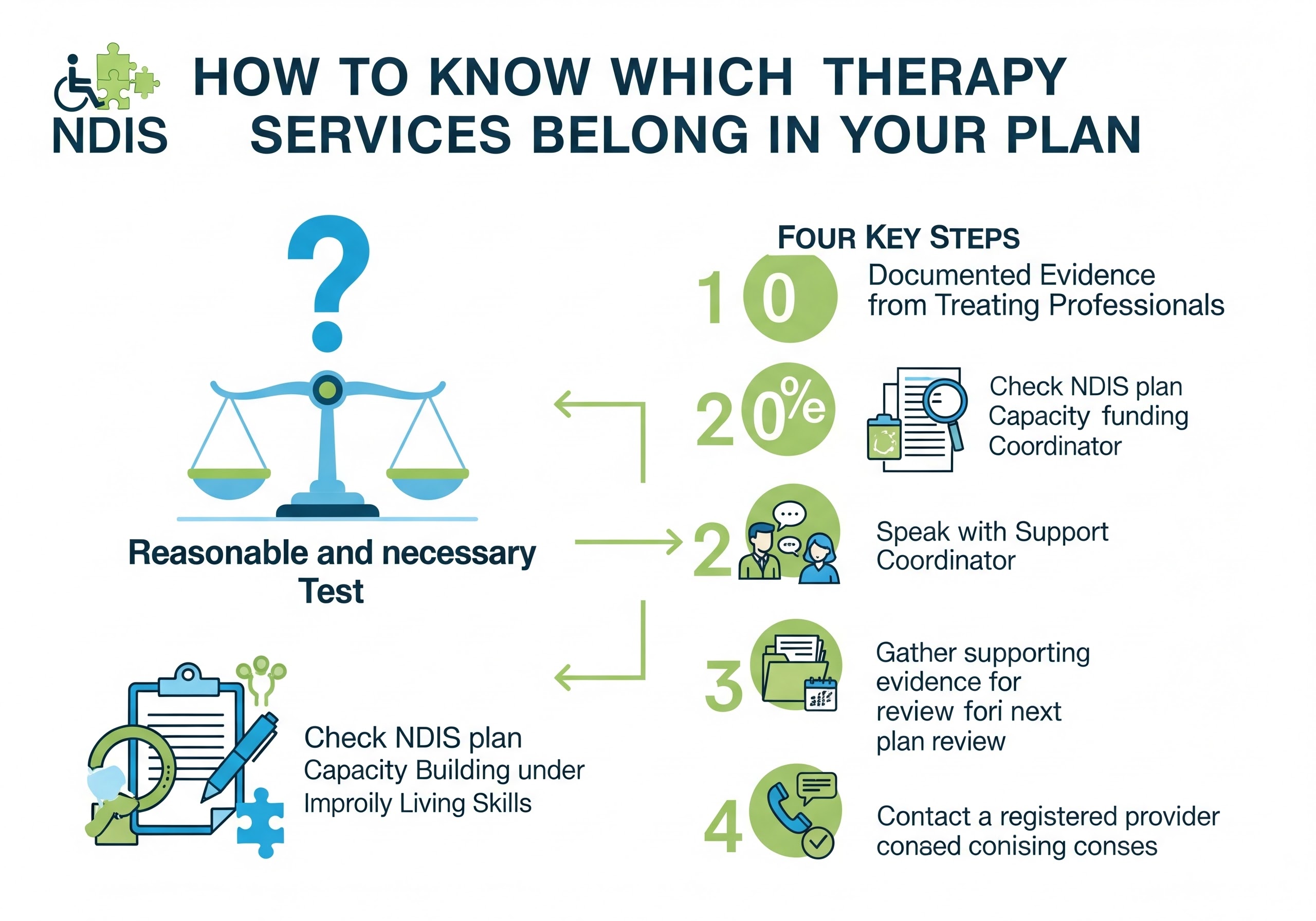
How to Know Which Therapy Services Belong in Your Plan
Not every NDIS participant will have all of the above NDIS therapy services funded. The NDIS applies a "reasonable and necessary" test to every support, and therapy funding is based on individual assessment of need, goals, and evidence.
The most reliable way to build a strong case for specific NDIS therapy services is through documented evidence from treating professionals. This includes reports from your GP, specialist, or existing therapists that clearly link the therapy to your disability and your NDIS goals.
Key steps to confirm and access NDIS therapy services:
Check your current NDIS plan for Capacity Building funding under Improved Daily Living Skills
Speak with your Support Coordinator about which therapy services your plan currently covers
If a therapy you need is not funded, gather supporting evidence for your next plan review
Contact a registered provider like JS Choice to discuss how allied health and therapy implementation can be arranged
How JS Choice Group Can Help
Understanding which NDIS therapy services are available is just the beginning. Putting them into practice, coordinating between multiple providers, and making sure therapy goals are reinforced in daily life is where real progress happens.
At JS Choice, our allied health and therapy implementation support helps participants bridge the gap between therapy sessions and everyday life. We work across Point Cook, Tarneit, Werribee, Hoppers Crossing, Laverton, Craigieburn, Footscray, and Melbourne's wider western and northern suburbs.
If you are ready to get more from your NDIS therapy services, we would love to talk.
Related reading: