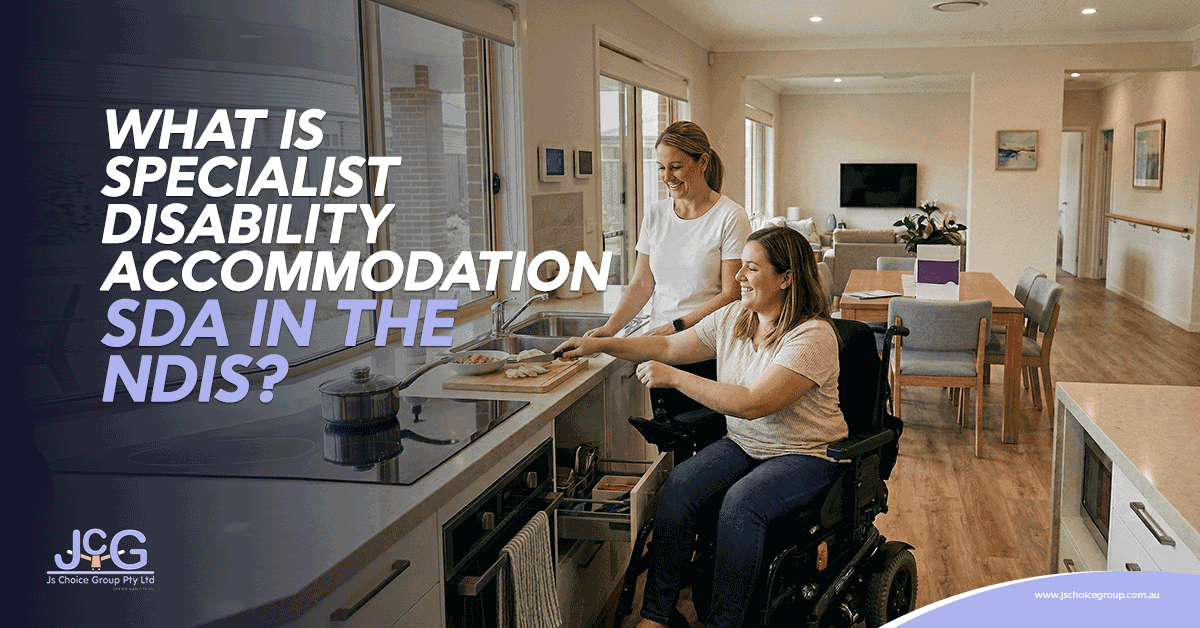
Most people do not know that the NDIS funds the home itself, not just the support inside it. For Australians living with extreme functional impairment or very high support needs, standard housing creates daily risks that purpose-built homes are specifically designed to remove.
That is what Specialist Disability Accommodation, known as SDA, does.
SDA is one of the most specific and least understood parts of the National Disability Insurance Scheme. It exists for a small group of participants whose disability means standard housing, even with modifications, cannot safely or adequately meet their needs.
This guide covers everything you need to know: what SDA is, who qualifies, the four design categories, how it differs from SIL, how much it costs, and how to start the application process in Melbourne.
New to the NDIS or unsure where to start? Book a free consultation with JS Choice Group — our team helps Melbourne participants understand their plan and access the right supports.
What Is Specialist Disability Accommodation (SDA)?
Specialist Disability Accommodation (SDA) is NDIS-funded housing built or significantly modified for people with extreme functional impairment or very high support needs.
SDA dwellings are purpose-designed with accessible features that help residents live more independently and allow support services to be delivered more effectively and safely. These features go far beyond what standard home modifications can achieve. They include ceiling hoists, reinforced walls, emergency backup power for medical equipment, and fully accessible bathrooms and kitchens.
SDA funding covers the physical building itself. It does not cover the support workers, daily care, or personal assistance a participant needs inside the home. Those services are funded separately, most commonly through Supported Independent Living (SIL).
Only around 6% of NDIS participants qualify for SDA. It is not a general housing benefit. It is a targeted capital investment for those whose disability creates housing needs that cannot be met any other way.
All SDA providers must be registered NDIS providers, and every SDA dwelling must be enrolled with the NDIA. The NDIS (Specialist Disability Accommodation) Rules 2021 govern all requirements for design, enrolment, pricing, and compliance.
SDA vs SIL: Understanding the Difference
This is the question that creates the most confusion for participants and families.
SDA is the building. It funds the physical structure of the home, its design features, and its maintenance.
SIL (Supported Independent Living) is the support inside the building. It funds the workers who provide daily personal care, overnight support, and assistance with daily tasks.
Most participants who live in SDA also have SIL funding in their plan. The two work together, but they are assessed separately, funded separately, and managed by separate processes within the NDIS.
A participant could have SDA funding for a purpose-built apartment and SIL funding for 24/7 support workers in that apartment. Removing either one leaves a gap. Getting both right is where the real work of housing planning happens.
Already on the NDIS and need help navigating your supports? Read our guide on how NDIS registered providers help participants achieve independence to understand how support services work alongside housing.
Who Is Eligible for SDA?
To access SDA funding, a participant must first be an active NDIS participant. From there, they must meet one of two eligibility criteria.
Criterion 1: Extreme Functional Impairment
The participant's disability severely limits their ability to manage mobility, self-care, or self-management, even when assistive technology is in place. Their physical limitations are so significant that the design of the building itself must be adapted to reduce risk and support daily functioning.
Criterion 2: Very High Support Needs
The participant requires substantial person-to-person support for most of the day, their informal support network cannot safely manage their care, and there are real safety risks associated with living in standard housing.
Both criteria require strong clinical evidence. A detailed Functional Capacity Assessment from an occupational therapist is the most important piece of documentation in any SDA application. It must demonstrate what the participant cannot do, why standard housing fails them, and how purpose-built SDA would address those specific needs.
Key eligibility facts:
Only active NDIS participants can apply for SDA
The disability must be permanent, temporary conditions do not qualify
Standard home modifications must be assessed and ruled out first
The NDIA will consider whether SDA improves independence, safety, and quality of life before approving
The Four SDA Design Categories
Every SDA property is built to one of four design categories, set out in the NDIS SDA Design Standard. The category approved in a participant's plan determines which properties they can access.
1. Improved Liveability (IL)
Designed for participants with sensory, intellectual, or cognitive impairments, such as intellectual disability, acquired brain injury, or autism where sensory processing is a key need. These homes feature luminance contrasts, tactile elements on walls and doorways, wider corridors, and improved wayfinding to help residents navigate their environment safely and independently.
2. Fully Accessible (FA)
Designed for participants with significant physical impairment, particularly those who use a wheelchair or have limited mobility. Key features include step-free access throughout the entire home, wider doorways and corridors, accessible bathrooms with turning space, accessible kitchen benchtops and appliances, and continuous accessible paths from the street to the dwelling.
3. Robust
Designed for participants whose disability involves complex behaviours that may pose a risk to themselves, other residents, or the property. These homes are built with reinforced walls and fittings, high-impact wall linings, soundproofing, secure doors and windows, laminated glass, and durable fixtures.
These are designed to reduce injury and minimise reactive maintenance. Robust SDA is often suited to participants with autism, psychosocial disabilities, or complex mental health conditions.
4. High Physical Support (HPS)
The most specialist category, designed for participants with very high physical support needs. HPS dwellings include all Fully Accessible features plus structural ceiling hoist tracking throughout the home, emergency backup power for medical equipment, power and control cabling for future automation, and comprehensive environmental controls that can operate without physical dexterity.
This category suits participants who require ventilator support or whose physical impairment demands the most intensive daily assistance.
Not sure which SDA category applies to you? JS Choice Group works with participants and families across Melbourne to understand complex NDIS plans and connect with the right supports. 📞 Call 1300 JS CHOICE or book your free consultation today.
SDA Building Types
SDA properties come in several building types, each with different pricing, community dynamics, and suitability depending on participant preferences.
Apartments — Individual units within a larger building, often with shared communal areas
Villas and townhouses — Smaller-scale shared living, typically 2 to 4 residents
Houses — Detached dwellings, available in shared or single-occupancy arrangements
Group homes — Shared residences housing up to 5 residents with significant support needs
Participants are not assigned to a building type. Choice and control applies here too. The approved design category narrows the pool of eligible properties, but within that pool, participants choose the dwelling that best suits their preferences, location needs, and personal goals.
How Much Does SDA Cost?
SDA funding is included as a line item in a participant's NDIS plan. The amount varies depending on three main factors: the design category, the building type, and the location band.
Annual SDA funding amounts range from approximately $28,000 to $117,000 or more per year, with High Physical Support properties in major cities receiving the highest funding contributions.
Participants pay a Reasonable Rent Contribution of approximately $147 per week in 2026, representing around 25% of the Disability Support Pension. This is paid to the SDA provider and is separate from any SIL or other support costs.
SDA does not cover electricity, internet, groceries, or other everyday living costs. These remain the participant's responsibility.
How to Apply for SDA in Melbourne
The SDA application process takes time. The full journey from initial assessment to moving into a property typically spans 12 to 24 months. Starting early is not optional. It is necessary.
Step 1: Get a Functional Capacity Assessment An occupational therapist assesses your functional limitations in detail, documenting what standard housing cannot safely provide and what design features are needed.
Step 2: Gather Supporting Evidence Medical reports, current housing assessment, and documentation from treating professionals all strengthen the application.
Step 3: Submit Through Your NDIS Plan or Plan Review SDA is requested through the NDIS home and living pathway. Your support coordinator or Local Area Coordinator can help prepare the submission.
Step 4: SDA Approved — Search for Properties Once SDA is included in your plan, you can search for available properties using the NDIS SDA Finder tool, which lists vacancies by location, design category, building type, and price.
Step 5: Sign a Service Agreement and Move In Once a suitable property is found, a service agreement is completed and you can transition into your new home.
A support coordinator who understands SDA is essential throughout this process. They can help you prepare strong evidence, navigate the NDIS system, and find available properties in Melbourne that match your approved category.
How JS Choice Group Supports SDA Participants in Melbourne
At JS Choice Group, we are a fully registered NDIS provider based in Point Cook, delivering disability support services across Melbourne's Western and Northern suburbs.
While SDA housing itself is built and managed by specialist property providers, we deliver the daily support services that make SDA living work in practice.
Our services for participants in SDA or exploring supported living include:
Assistance with Daily Life — Personal care, household support, and daily routine assistance
Community Nursing Care — Professional clinical support for complex health needs at home
Social and Community Participation — Building social connection and community belonging
Transport Assistance — Safe, reliable travel to appointments, activities, and community events
Psychosocial Recovery Coaching — Specialist support for participants with psychosocial disabilities
Emergency Respite — Flexible carer relief when families need a break
We serve participants across Point Cook, Werribee, Tarneit, Hoppers Crossing, Sunshine, Footscray, Broadmeadows, Melton, and surrounding areas. Support services are available 24 hours a day.
Frequently Asked Questions About SDA
What is the difference between SDA and SIL?
SDA is the building, purpose-built housing funded by the NDIS. SIL is the daily support provided inside the home by trained workers. Most SDA participants have both SDA and SIL funding, but they are assessed and funded separately.
Can I choose which SDA property I live in?
Yes. Once SDA is approved in your plan, you choose from available properties that match your approved design category using the NDIS SDA Finder. You are not assigned housing.
Can I live alone in SDA?
In some cases, yes. Most SDA properties are shared with a small number of other residents, but single-occupancy arrangements are available where they best meet a participant's needs.
How long does the SDA application process take?
The full process from initial occupational therapy assessment to moving into a property typically takes 12 to 24 months. Participants are advised to begin the process well before their current housing becomes a crisis situation.
Does SDA funding cover all my housing costs?
No. SDA funding covers the specialist building costs. Participants pay a Reasonable Rent Contribution of approximately $147 per week in 2026, plus everyday living costs such as electricity and internet.
What evidence do I need for an SDA application?
A detailed Functional Capacity Assessment from an occupational therapist is the most important document. Supporting reports from treating professionals, current housing assessments, and risk documentation also strengthen the application.
Conclusion
Specialist Disability Accommodation is one of the most significant supports the NDIS offers for participants whose disability creates real and serious housing challenges. It exists not as a general housing option, but as a targeted investment in the safety, independence, and dignity of people who genuinely need purpose-built environments to live well.
Getting SDA right takes time, strong evidence, and the right team around you. If you are at any stage of this process, whether just starting to explore options or already preparing an application, speaking with a registered provider who understands the full picture of NDIS housing and daily support is the right first step.
Ready to take that step? Book a free consultation with JS Choice Group, call us on 1300 572 464, or email at info@jschoicegroup.com.au.
Office hours: 8am to 6pm. Support services available 24 hours a day.